
Scripts / Star Donor
Star Donor
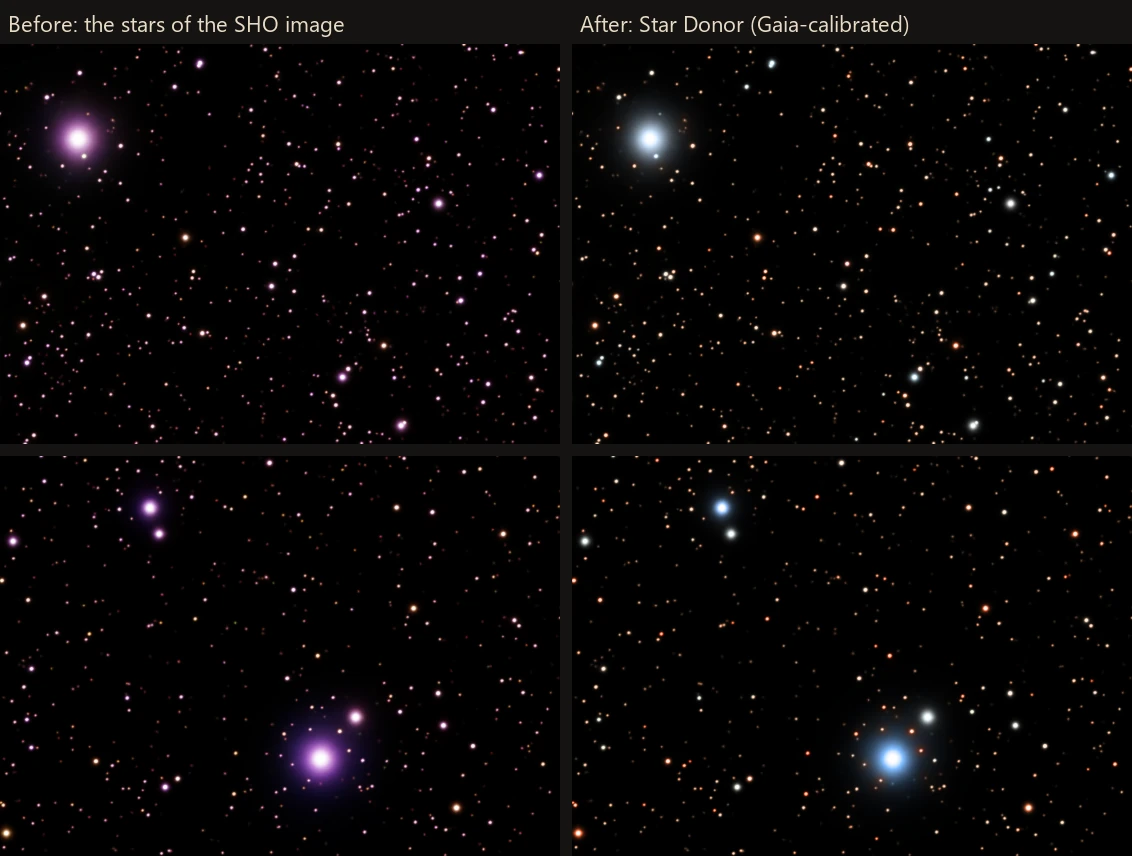
Gives the stars of a narrowband image the colors an RGB camera would have recorded, learned from the Gaia DR3 catalog for your own field and calibrated like SPCC, with a Sun-like star as white.
Overview
In a narrowband image the stars take the colors of the palette: magenta, green or teal stars in an SHO image. Star Donor gives them the colors an RGB camera would have recorded. It looks up the stars of your field in the Gaia DR3 catalog, whose spectra say what color each star is through RGB filters, and learns from those stars how your image's channel ratios translate into real colors.
Every star in the image is then colored from its own ratios, including the many stars Gaia has no spectrum for. The colors are calibrated the way SPCC calibrates a broadband image, with a Sun-like star as white, and each star keeps its brightness.
Give it one color stars image, or the stars of the Hα, OIII and SII masters separately, linear or stretched. A preview shows the stars before and after within a second or two, and a Calibration readout gives the color error on stars the map did not learn from. On my Wizard Nebula and Elephant's Trunk data that error was 1.4-1.6° median. Against the Elephant's Trunk shot through real RGB filters and calibrated by SPCC (436 stars, colors compared as they come), the median hue error was 4.1° for linear output (2.8° once the two are balanced to each other) and 6.4° for stretched output, where bright star cores turn white as in any stretched image.
Features
Source
- One color stars image (SHO, HOO or a dual-band color camera), or the stars of the Hα, OIII and SII masters
- Linear or stretched input, detected automatically
- Plate solution from the stars image or a solved master of the same field
- Images picked automatically from their names
Color target
- Typical RGB (Astronomik Deep Sky curves) for a mono camera, or a color camera with or without a UV/IR cut filter
- Any RGB filter set in SPCC's database, your own included
- Eye (CIE 1931) for star colors as the eye sees them
Calibration
- Gaia DR3 spectra through the target's filter curves, read with PixInsight's Gaia process
- A map from your channel ratios to real colors, checked on stars it did not learn from
- Median and 90% color error with a GOOD, FAIR or POOR badge
- Strips of Gaia's colors against the learned ones, hot to cool
Adjust and apply
- Saturation, with 1.00 as the calibrated color
- Gaia stars take their catalog color, or every star the learned one
- Optional star stretch that keeps each star's color
- Apply recolors the stars image as one step in its history, or makes a new color stars image from Hα, OIII and SII
Install
Add the FederAstro repository to PixInsight once. PixInsight then installs Star Donor and offers every future update automatically. Everything in it is signed by a Certified PixInsight Developer.
- In PixInsight, open Resources ▸ Updates ▸ Manage Repositories.
- Click Add and paste
https://federastro.com/pixinsight/ - Click OK, then open Resources ▸ Updates ▸ Check for Updates.
- Apply the update and restart PixInsight when it asks.
- Open it from Process ▸ FederAstro ▸ Star Donor.
Requirements
- PixInsight
- 1.9.5 or later
- Platforms
- Windows (64-bit) and macOS (Apple silicon)
- Type
- PixInsight module (a process with its own window)
- Images
- Stars-only images (StarXTerminator or similar): one color stars image, or the stars of the Hα, OIII and SII masters; linear or stretched
- Plate solution
- The stars image's own, or a solved image of the same field and size
- Gaia
- The Gaia DR3/SP database set up in PixInsight's Gaia process (the one SPCC uses)
- License
- Free
Changelog
Version 0.1.0
- First release: star colors for narrowband stars images, learned from Gaia DR3 and calibrated like SPCC
- One color stars image, or the stars of the Hα, OIII and SII masters; linear or stretched
- Typical RGB, your own RGB filters or Eye (CIE) as the color target; Calibration readout and strips
- Saturation, Gaia or learned colors, and an optional star stretch
Credits and license
Star Donor is written by afeder (FederAstro). This work has made use of data from the European Space Agency (ESA) mission Gaia (https://www.cosmos.esa.int/gaia), processed by the Gaia Data Processing and Analysis Consortium (DPAC, https://www.cosmos.esa.int/web/gaia/dpac/consortium). Funding for the DPAC has been provided by national institutions, in particular the institutions participating in the Gaia Multilateral Agreement. Star Donor uses the Gaia DR3 sampled spectra through PixInsight's Gaia process and the filter curves of SPCC's database (Spectrophotometric Color Calibration, by Pleiades Astrophoto). This product is based on software from the PixInsight project, developed by Pleiades Astrophoto and its contributors (https://pixinsight.com/).